Universal Laser Power Beaming TechnologyThe most valuable machines in orbit are also the most overbuilt.
A large geostationary satellite can cost a few hundred million dollars and is expected to work for fifteen years or more, holding the same slot over Earth the entire time. To last that long, its solar array is not sized for the power it needs on launch day. It is sized for how weak it will be at the end, after fifteen years of radiation slowly eating the cells. So on day one it generates well over twenty percent more power than the satellite can use, and that surplus is simply wasted, for years, until the panels finally decay down to it. Almost every critical system is doubled or tripled too, because if something fails out there, nobody is coming.
The result is a spacecraft that is deliberately, expensively overbuilt, hauling capability it will not need until the very end of its life, if ever.
That overbuild has a name, even if the industry rarely says it out loud. Call it the self-sufficiency tax. A satellite makes all of its own power and lives entirely on what it carries, so it has to be built for the worst moment it will ever face, then drag that worst-case hardware through the whole mission. The biggest spike. The deepest degradation. The longest stretch without sun. You pay for all of it up front, in mass, volume, and launch cost, then watch most of it sit idle.
GEO just pays the most visible version of the bill. Drop lower, and the tax does not disappear. It just changes shape.
What changes as you descend is the dark. A geostationary satellite barely sees night at all; it sits in near-constant sunlight and only slips into Earth’s shadow for a few weeks around each equinox. Come down into low orbit and that flips hard. A satellite a few hundred kilometers up is eclipsed on roughly a third of every lap, with a long cold night baked into each ninety-minute orbit. Keep falling toward very low orbit and it turns brutal: past forty percent of every orbit in shadow, climbing toward an even split the lower you fly. The lower and cheaper the orbit looks, the more of its life the satellite spends in the dark.
And the dark is the most expensive place a satellite can be, because that is when it runs on batteries. This is the part of the tax almost no one thinks to question. A battery has to be sized for the full load across the longest eclipse, then sized up again because you can only drain it part way if you want it to survive thousands of charge cycles a year, then sized up once more for the worst power spike the mission will ever ask for. What you end up with is a heavy, bulky, expensive block of cells whose entire job is getting the satellite through the night. In the lowest orbits it can become one of the largest things on the whole vehicle. We have quietly accepted that every satellite must carry its own personal power plant through every eclipse of its life, and almost nobody has asked the obvious question: what if it didn’t have to?
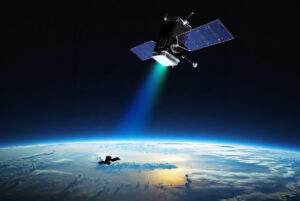
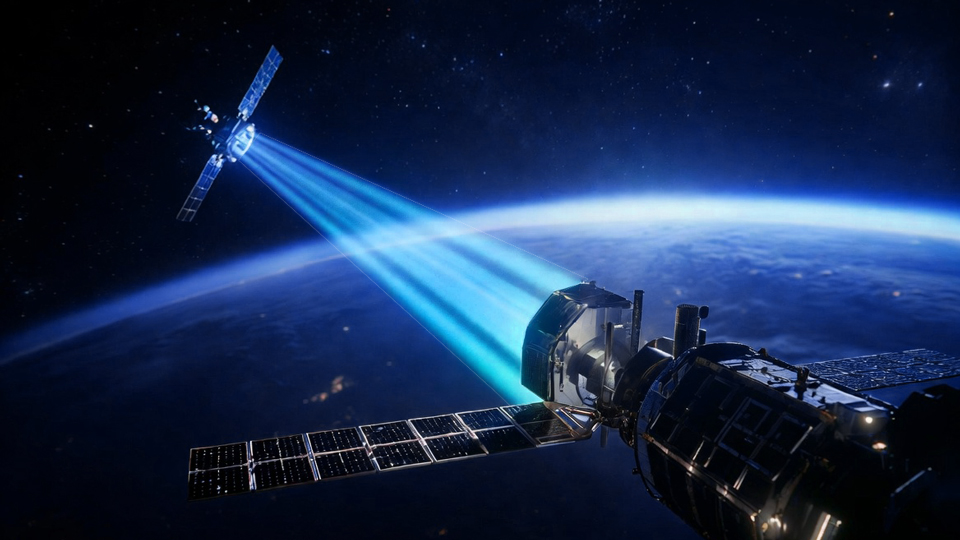
What if power could arrive from outside, on demand, the instant the panels go quiet or the load spikes? Then you stop designing for the worst moment and start designing for the average one, borrowing the rest. The battery shrinks. The array shrinks. The redundancy you were buying as insurance becomes a service you call only when you need it. That is what laser power beaming offers: a transmitter in orbit that sends concentrated sunlight straight onto a satellite’s existing panels, with nothing new to bolt on. The self-sufficiency tax suddenly becomes optional.
This is what could be unlocked with Space Power, mission by mission.
- GEO (Geostationary Orbit). Start where the tax is most expensive, because beaming pays off there twice. The first win needs no new satellites at all. Space Power’s beam works with any solar array, old or new, with nothing to install on the spacecraft, so it can top up a geostationary satellite whose panels have faded with age and hand it years of extra life, or rescue one whose power is failing, an orbital jump start for an asset worth hundreds of millions. Tugs can already dock with aging GEO satellites to nudge them around, but none of them can replace a worn-out array. A beam does not have to. It just puts the power back, into the fleet that is up there right now. The second win is in the satellites still on the drawing board. They no longer have to be built as fortresses of oversized arrays and tripled backups, sized around how weak they will be in fifteen years. They can be built for the power they actually use and call on beamed power for the rest, buying redundancy as a service instead of launching it and praying they never need it.
- VLEO (Very Low Earth Orbit). Some missions want to fly as low as possible, because getting close to Earth means cheaper launches, sharper images, and the same radar or camera performance from a smaller payload. The price is air. The atmosphere never fully ends, and down low there is enough of it to drag on the spacecraft constantly, with the solar array itself acting as the biggest sail. So the design eats itself: drag demands propulsion, propulsion demands power, power demands a bigger array, and the bigger array makes more drag. The air also breathes with the Sun, swelling during solar storms and pulling on satellites with little warning. Skylab fell years early for exactly that reason. And because these orbits sit so deep in the dark, they carry the heaviest batteries of all. Beaming hits the whole knot at once: a smaller array means less drag, an outside supply feeds the constant appetite of electric propulsion, and borrowed power through the long eclipse means a smaller battery and a smaller, cheaper vehicle. For these platforms, power is not a subsystem. It is the entire design problem.
- SAR and direct-to-cell, the peak-power addicts. Synthetic aperture radar satellites map the planet by firing intense pulses of radio energy and reading the echoes, which lets them see at night and through cloud. But the radar fires for only five to ten percent of each orbit. The rest of the time the satellite is recharging and dumping heat, a whole machine built around a burst it spends most of its life recovering from. You would expect operators to respond by building bigger satellites that image more of each orbit and earn more apiece. Recent trends point the other way. The business model centers on coverage, the ability to see anywhere on Earth even once a day, so the move has been toward more satellites flying shorter active windows, smaller and cheaper, rather than fewer large ones running longer. The smartest beaming play fits that grain. Instead of every satellite carrying its own giant peak-power generator, a constellation can share power sources across its members, beaming each burst on demand so the whole fleet flies lighter and shoots more often. Direct-to-cell constellations face their own version of the problem. Connecting ordinary phones straight to satellites takes enormous power, and that demand arrives in peaks, surges of traffic the whole power system must be sized to survive even though they pass quickly. Here too the expensive part is the spike, and the spike is exactly what an outside source can absorb.
- Re-entry capsules and orbital factories. A new kind of spacecraft now manufactures things in orbit and flies the product home. Companies are already flying capsules that grow pharmaceutical crystals in microgravity and return them to the ground. Their tax is shape. A capsule that has to survive re-entry needs to be compact and heat-shielded, and big fragile solar wings are the last thing you want bolted to something about to hit the atmosphere at orbital speed. So the vehicle is starved for surface area exactly where its furnaces are starved for power. Beam the energy in, and the capsule keeps its clean returnable shape, runs its process at full power, and never has to stop to recharge.
- In-orbit servicing and agile defense craft. These are the tow trucks, fuel tankers, and bodyguards of orbit. Their lives are mostly waiting, broken by short bursts of intense work: catching a tumbling satellite, repositioning fast, reacting to a threat. To stay ready, they keep peak capability armed at all times, even while idle, and once docked beside a client the extra power hardware fights for room that does not exist. The same pressure drives high-power electric propulsion for agile, maneuvering spacecraft, which is squarely a defense interest. Borrowed power on demand gives them the reserve without the deadweight and the agility without the oversized array.
- Orbital data centers and stations. The newest and hungriest customers barely existed a few years ago: data centers in orbit and the large stations they resemble. These are enormous structures with enormous, spiky appetites, and the bigger they get the more absurd it becomes for each one to carry its own worst-case generator and full backup. It is cheaper to size the station for its average load and contract the peaks and the redundancy to an outside provider, the way a building draws from the grid instead of running its own plant.
Run down the whole list and the pattern is identical every time. Stop carrying your worst case. Borrow it instead. And the technology to do that is real and moving fast. The first orbital power-beaming systems are already being built and tested, an external supply that frees a spacecraft from having to haul its own worst case, so it can be designed around what it actually needs rather than everything it might ever need.
Whether beaming wins on a given mission still comes down to the orbit, the duty cycle, and the price, and that is the question worth solving. But the self-sufficiency tax is real at every altitude, from the faded arrays of geostationary giants to the heavy batteries of satellites skimming the top of the atmosphere. Every satellite flying today is paying it. For the first time, there is a way to stop.